
Why a pre-designed template isn’t always the best solution
Canva (or whatever your weapon of choice is at 11pm the night before a session) will happily hand you a workbook template with a reflection page, a quiz, a fill-in-the-blank diagram, maybe a little “your goals” tracker at the front.
But none of that means any of it belongs in yours.
A quiz might be brilliant… for someone else’s session. If it doesn’t map onto what you’re actually teaching, or how your audience learns, it’s just a filler.
And people can tell. Not consciously maybe, but they can feel when something’s been dropped in because the template had a space for it, rather than because it’s doing a job.
How is your workbook going to be used?
This is the one I think gets skipped over the most. Is this workbook meant to be followed along with, live, in the room? Or is it something people pick up afterwards to refer back to, when the session’s a memory and their handwriting’s gone a bit feral after the first sentence?
Because notes taken in the moment rarely make sense when you read them back afterwards… half a sentence, an arrow pointing at nothing, “ask about this!” with no context whatsoever.
If your workbook’s only ever going to be used in the room, alongside you talking, it can lean on shorthand and prompts because you’re there to fill the gaps.
But if it’s meant to work after the session, not just during it, then it changes what needs to be on the page.
Instructions need to be a bit more spelled out and activities need enough context that they still make sense weeks later.
Will your workbook be printed or editable?
Are your clients digitally savvy or do they want something physical in front of them they can scribble on?
If it’s print, is that happening at home on someone’s slightly dying inkjet, or is it going off to a professional printer? Because that decision alone affects how you setup the document.
Get it wrong and you’re either eating someone’s ink alive or sending off a file that doesn’t print the way you designed it.

I
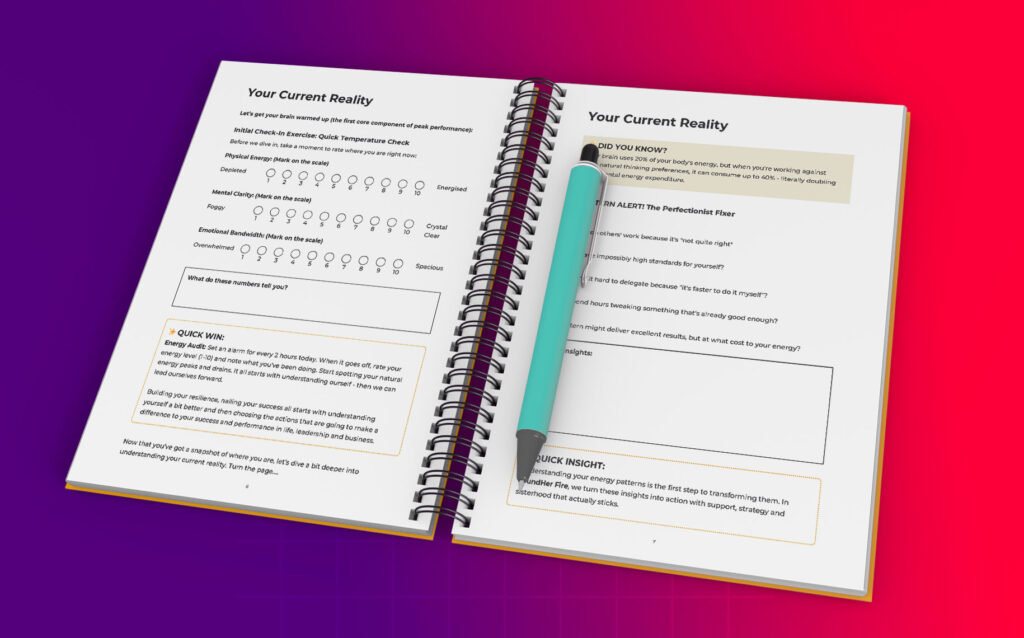
created Sarah Knight’s Fixers Energy Workbook as a dual purpose workbook. It has been set up so it can be typed on or printed out easily on a home printer without using tonnes of ink and has enough space to write.
Notes, or reference material?
If your workbook’s mainly there for people to write in, notes, reflections, answers to prompts, then space is the priority.
Wide margins, lines or boxes that are actually big enough to write in (not the tiny gap templates love to give you), and a structure that follows the shape of the session so people aren’t hunting for where they’re supposed to be writing.
But if it needs to hold onto things for later, important charts, key stats, a photo from a slide they’ll want to reference again, a model or framework they’ll come back to after the session’s long gone, then it’s doing a completely different job.
That’s reference material, and reference material needs to be found again easily. Think page numbers, a contents page, maybe consistent visual markers so someone flicking through six months later can spot the bit they need without rereading the whole thing.
Most workbooks actually need a bit of both, but not in equal measure, and that balance depends on your session.
A one day intensive workshop probably leans more towards notes, because people are living in the moment with you.
A workbook that supports an ongoing programme, something people will dip back into over weeks or months, needs to lean more towards reference, because its job isn’t finished when the session ends.
The science behind writing in a workbook
There’s a chunk of research behind why physically writing something down helps it stick better than just reading it or listening to it.
One of the more well known studies, from Pam Mueller and Daniel Oppenheimer, found that people who took handwritten notes actually understood the material better and could remember more of it afterwards than people who’d typed their notes, with research from Princeton and UCLA finding that students who took notes by hand understood concepts better.
A separate study published in the Journal of Writing Research found something similar, that people had noticeably better free recall of words they’d handwritten compared to typing them on a laptop or tablet keyboard.
Part of the thinking is that handwriting takes more effort than typing, and that effort is what helps the memory form.
If you want your audience to actually remember what they learned, not just leave with a nice looking document, giving them space to write matters more than it might seem.
Live session, or standalone course?
A workbook built for a live, fast paced session and a workbook built for a self paced course are not the same thing, even if the content overlaps.
In a course, people have time. They can sit with an activity, come back to it a day later, mull it over before answering. That means you can include things like longer reflective prompts, or activities that ask someone to go away and try something before coming back to the workbook.
In a live session, you haven’t got that luxury. If an activity takes someone five minutes to understand what they’re even meant to be doing, you’ve lost five minutes of your session and probably some of the room’s energy with it.

Tailored workbooks = long lasting value
None of this is about ticking boxes or following a formula. It’s about thinking about what works best with your session, your audience, and what you want them to walk away remembering, before you even start creating your workbook.
Because when a workbook’s been properly considered, it doesn’t just look good. It does its job long after you’ve packed up and gone home!